

In March 2026, we shared draft AI Design Principles for the IB Ecosystem, our first step in developing a set of tools to support IB learners, educators, schools and the wider ecosystem in their adoption of AI. Over the last few months, we have been refining and co-creating the Principles and other tools with the IB community that will use them. This is an update on that work: the co-creation so far, the refinements we’ve made, the lessons we’ve learnt, and where we will focus next.
The co-creation so far
Co-creation is central to the Digital Blueprint. It is shaping how we are re-designing our role in fulfilling the IB Ecosystem’s digital needs, and is central to our work to better support our learners, educators and schools with AI. When we published the draft AI Design Principles in March 2026, we requested feedback from our IB community on the Principles and to tell us what would make the them work in their schools, classrooms and beyond. More than 1,500 educators from 119 countries have provided that feedback, either via our online survey or in-person at one of the 11 co-creation sessions we have held in Mumbai, Johannesburg and Denver.
Co-creation session at the African Education Festival, Johannesburg, April 2026
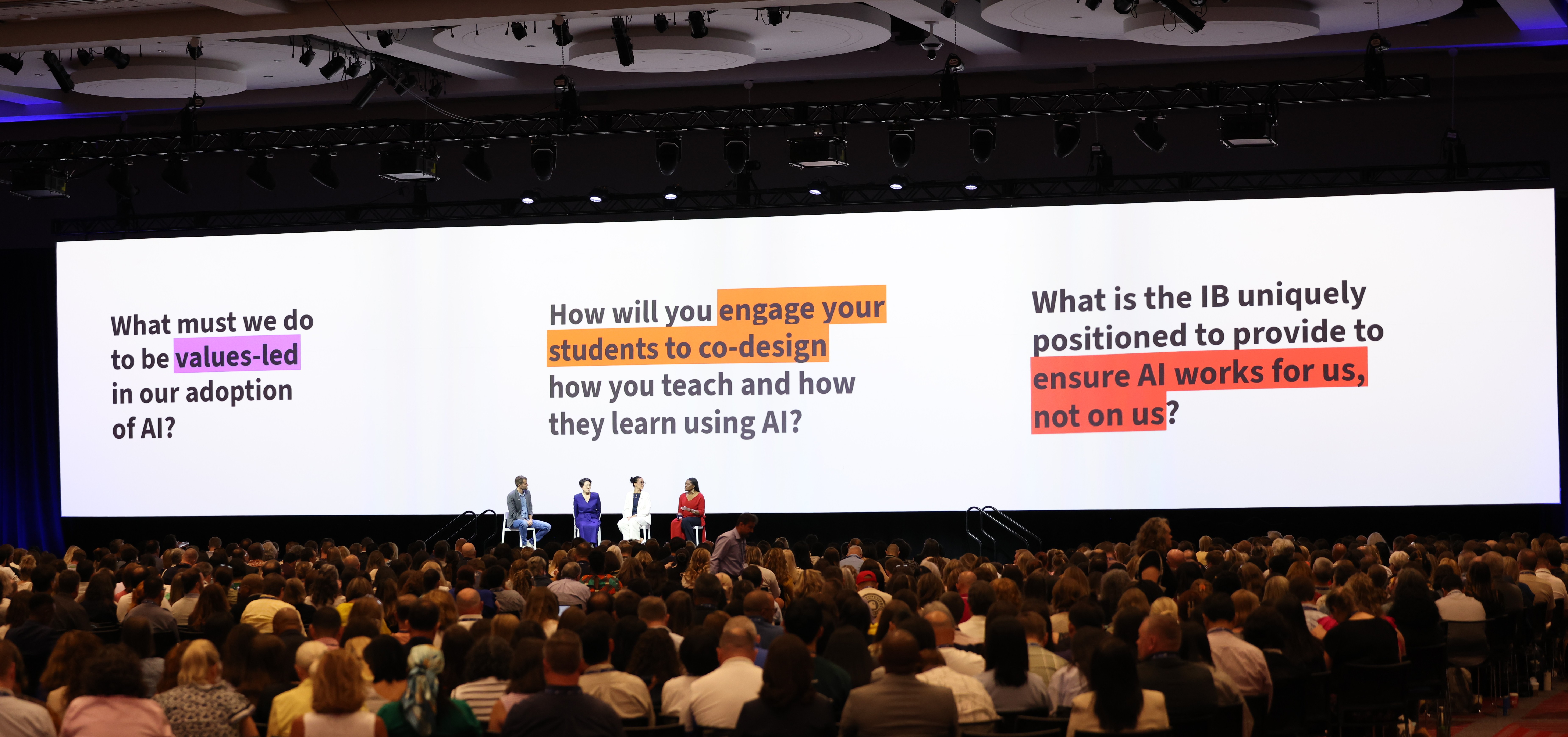
In our plenary session at the IB Global Conference in Denver (18th July 2026) we asked what role each of us needed to play in the learning ecosystem in a digital and AI world. The emphasis was on being values-led, shared responsibility and ensuring AI works for us and not on us across our whole community.
The AI keynote panel at the IB Global Conference in Denver, July 2026: Loic Tallon (Chief Digital and Data Officer, International Baccalaureate), Dr Yuhyun Park (Founder, DQ Institute), Dr Marsha Maxwell (Head of Innovation, Research and Technology, Atlanta International School) and Ketty Dones (IB alumna and Community AI Strategist, University of Central Florida's Applied AI Innovation Initiative)
As Dr Marsha Maxwell, Head of Innovation, Research and Technology at Atlanta International School, told the room, defining what matters most in education is too important to outsource. That work belongs to all of us, and this update is what it looks like in practice.
How this work has evolved
The principles have been refined in response to community feedback, and two changed at the level of the title itself. Our first principle had been called Caring and balanced, but feedback indicated this was not enough: greater emphasis was needed on protecting learners.
|
From |
To |
|
Caring and balanced: AI for human flourishing |
Caring and protective: AI for human and planetary flourishing |
Our draft principle about educator agency in AI decisions has been refined based on feedback this placed too great a responsibility on educators and too little on everyone else. One educator was blunt about where the responsibility sits. “Safeguarding cannot sit with students or educators alone. It is also the responsibility of the organisations and companies building these tools.”
|
From |
To |
|
Educator agency: guided by capability, grounded in responsibility |
Shared responsibility: across the IB ecosystem |
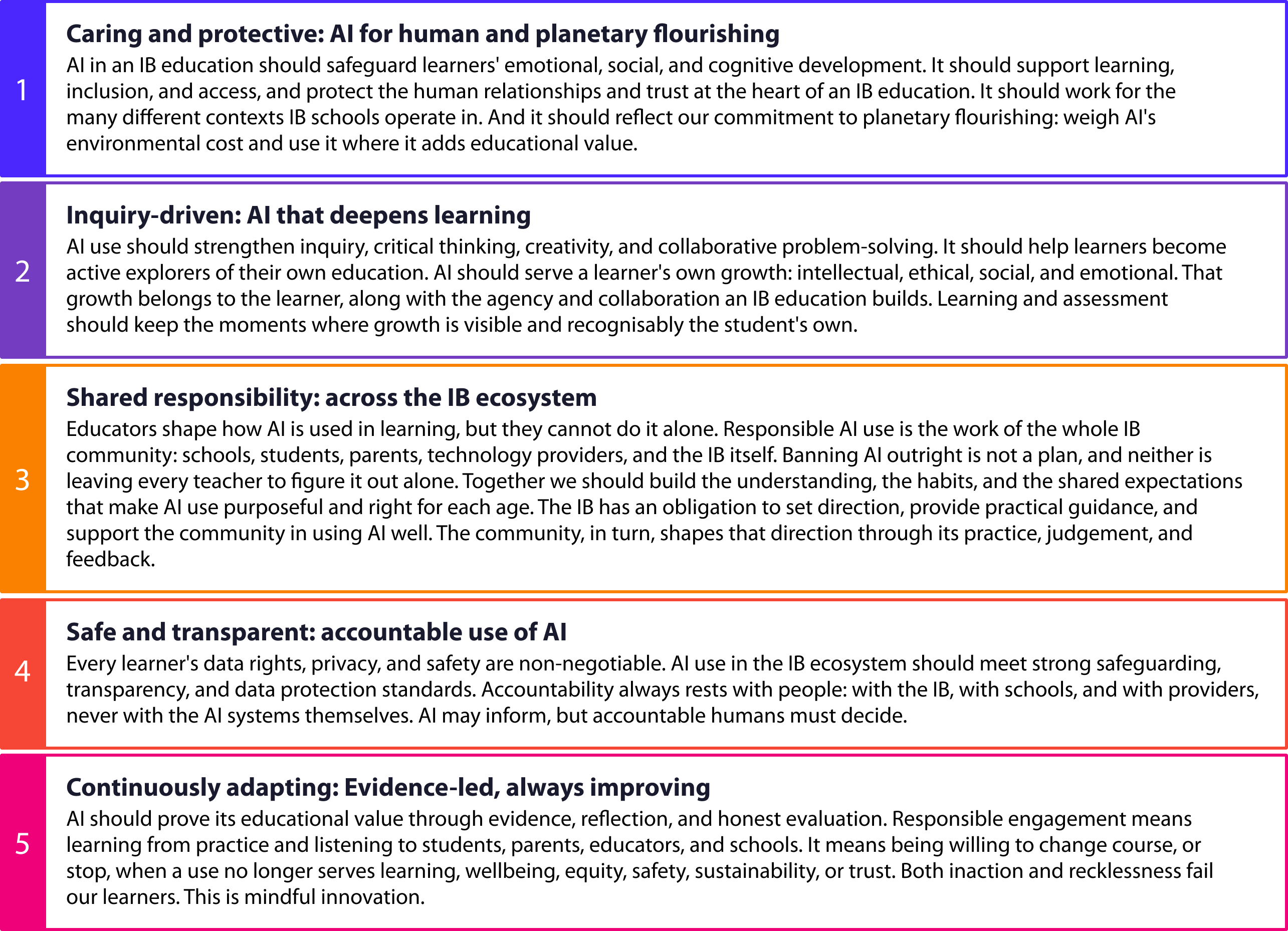
The full set of refined AI Design Principles are available here.
From principles to practice
The principles set the direction, but we also want to provide practical guidance on how to act on them. We’ve therefore been working with the community to design an AI toolkit: practical resources that anyone in the IB ecosystem can pick up and use. Seven draft tools, drawn from the survey and the co-creation sessions, and shaped with our external advisors, are now being further tested and prioritized with the community. These are:
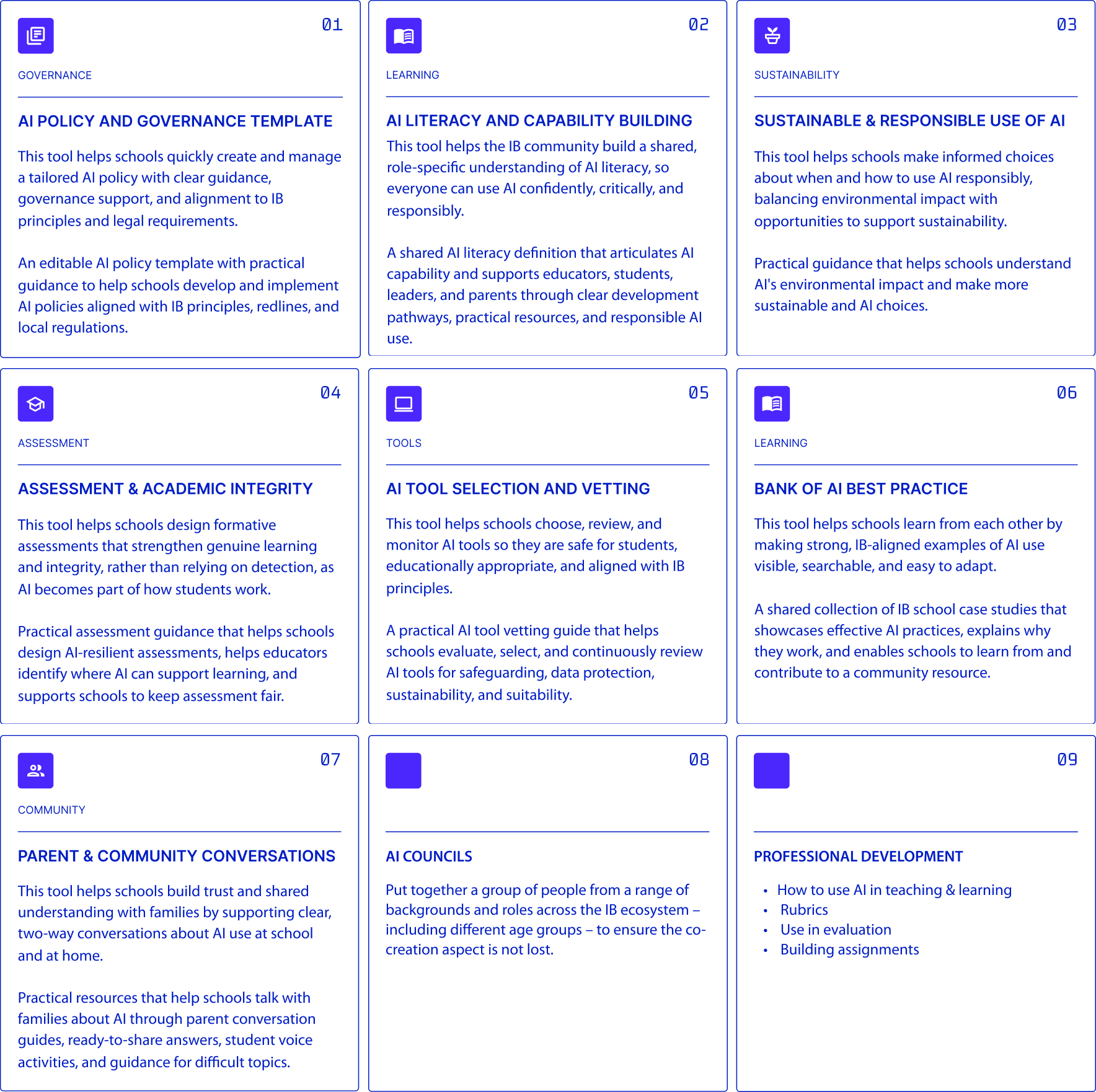
The AI toolkit taking shape: the seven draft tools tested and ranked by the community, with two additions, AI Councils and Professional Development, co-created with participants at the Denver sessions in July 2026.
What the co-creation has taught us
- Governance comes first. Support in developing policy and governance is the number one priority for our community. This came out clearly from our survey and in our in-person co-creation sessions. Whilst not deemed to be the most exciting aspect of AI adoption, it is widely-recognized as the foundation everything else builds on: one group summed it up in three words, “must start here.” Based on this feedback, the development of a policy and governance toolkit adapted to the different members of our ecosystem is our next priority.
- Educators want support on AI capabilities and literacy. As one group put it, “educators cannot be expected to guide students on AI before they have had the chance to develop those skills themselves.” Participants also drew a distinction that stuck with us, separating the AI literacy educators need for their own professional practice from the guidance they need for the classroom, where the job is teaching students to use AI well. Professional development came up so often that participants proposed it as a tool in its own right, and we are working with our professional learning team on what both pathways would take.
- Students must be in the conversation. Student participants have brought unique perspective and energy to our AI co-creation sessions: their role in shaping our response to AI requires formalizing. Student AI leadership councils were proposed: groups in which students help shape their school’s AI expectations. While families, they told us, need age-appropriate guidance and clear information about the difference between tools used at home and tools approved by a school. We are now developing guidance to help educators and students create AI councils in their schools.
- Protect human flourishing. One concern ran deeper than any other. Will AI use help learners flourish, or quietly take over the things that make them flourish? As one educator in Mumbai put it, “AI must be a tool, not an emotional or social substitute.”
Substitution is the fear underneath much of what we heard. Participants worry that AI could stand in for the relationships, the effort and the judgement that an IB education is built on. Those are not inefficiencies for AI to remove. They are what flourishing is made of. And the community's confidence sits right beside that fear, because the IB Learner Profile, focused on who a learner becomes, and our ATL skills give schools a strong foundation for an AI-present world. Participants paired that confidence with urgency. Act now. The planetary half of our first principle came up too, including AI's water and energy costs. This is a challenge no school can solve alone, and we will navigate it together as a community, starting with what schools can ask of technology providers.
- The IB must provide AI leadership. Our community is seeking more leadership from the IB on the adoption of AI in a manner aligned with the IB’s pedagogical values, and which can adapt over time as world forces and AI development continues a-pace. We also hear – and share – the concerns that the current trajectory of AI development is undermining pre-requisites for human and planetary flourishing, including human meaning, identity, agency and purpose. The IB’s leadership role in how AI designed, governed and made available across the IB Ecosystem requires greater definition.
What comes next
Implementing the Digital Blueprint, and ensuring the IB Ecosystem has the AI support it requires to flourish is a multi-year journey, but we are now well on the road. Our priorities over the coming months will include:
The principles. The updated principles have been iterated with input from across the IB community and are moving into final review, and they will keep evolving. You can give feedback on the principles at any time here, and we commit to reviewing responses each quarter to shape the next revision.
The toolkit. We are starting to design the highest-priority tools in the toolkit, starting with:
- AI policy and governance template. How can this tool support schools navigating many different international, national, state and district policies?
- AI literacy for educators. How can we best support the two pathways: professional practice and classroom teaching?
- Student AI leadership councils. What guidance would schools and students need to make councils work in practice?
We will share progress at the IB Global Conference in Lyon, in October 2026, and in upcoming virtual workshops.
Defining the IB’s AI leadership role. We will be finalizing a white-paper that outlines the IB’s posture on AI in education, including the partnerships needed to shape how AI is deployed across the ecosystem. We want to help ensure that the conditions under which AI operates are aligned with the IB mission and vision, and that the IB acts as a leader in AI for education and a steward of its responsible development in service of learners globally.
How to be involved
Join a virtual co-creation workshop. Sessions run between August and November, and you can sign up here.
We will be at the IB Global Conference in Lyon in October. The co-creation will continue, and we want to hear what these tools look like from inside your school.
Thank you to everyone who brought their questions, ideas and enthusiasm. Keep co-creating with us.
Our collaborators
Turning the community's feedback into redrafted principles, guidance and tools is the work of teams from across the IB, together with our external advisors:
- Deepanshu Arora, Co-founder and CEO, Toddle
- Clara Hawking, Co-founder and Executive Director, Kompass Education
- Markku Pelkonen, Founder, Growth Resilience
- Dr Yuhyun Park, Founder, DQ Institute
