

We’re taking the next step in shaping how the IB community approaches AI. Following the publication of the Digital Blueprint in November, a team of IB colleagues and external advisors has been working on tools to better support IB learners, educators, schools and the wider ecosystem in their adoption of AI. The AI Design Principles will be the first such tool.
The goal of the AI Design Principles is to help guide how artificial intelligence should be used across the IB ecosystem. We share them today in draft form to invite feedback and co-creation with the IB community that will use them.
The draft principles are:
- Caring and balanced: AI for human flourishing
- Inquiry-driven: AI that deepens learning
- Educator agency: guided by capability, grounded in responsibility.
- Safe and transparent: AI that is accountable
- Continuously adapting: evidence-led, always improving
These proposed principles are grounded in the IB Learner Profile, which describes the kind of human being an IB education develops. The goal is to ensure that AI strengthens that development across the IB ecosystem, in the work of the IB itself, by schools, and by the technology partners who serve our community.
What we've been doing
When we published the Digital Blueprint in November, we identified three ways the IB would approach technology: systems thinking, partnerships, and mindful innovation. We also recognised a reality many of you live every day: market forces alone are unlikely to yield technologies that align with the educational values and needs of the IB ecosystem.
Nowhere is that more evident than with AI.
Across our community, schools are navigating AI under real pressure. Parents are asking questions. Educators are experimenting — often without clear guidance. Technology providers are moving fast. And school leaders are making consequential decisions about tools, policies, and practices with limited support.
We believe the IB has a responsibility to guide — not by telling schools what to do, but by providing a clear, values-led foundation that schools can adapt to their own contexts.
Creating the Draft Principles
In February, we brought together a small group of external advisors — including Clara Hawking, Deepanshu Arora, Markku Pelkonen and Dr Yuhyun Park — alongside IB colleagues in assessment, programmes, safeguarding, compliance and digital. Across two working sessions, we identified priorities, risks, and non-negotiables for AI use in education. We consulted frameworks from the OECD, UNESCO, the Brookings Institute,the European Commission, the DQ Institute, and grounded everything in the IB's own educational philosophy.
The result is our first draft of the five AI Design Principles.
These are not the finished product. They are a starting point, ready to be stress-tested by the community that will use them.
The Principles in Detail
Grounded in our mission. Guided by the Learner Profile. Shaping AI to serve the learners we develop.
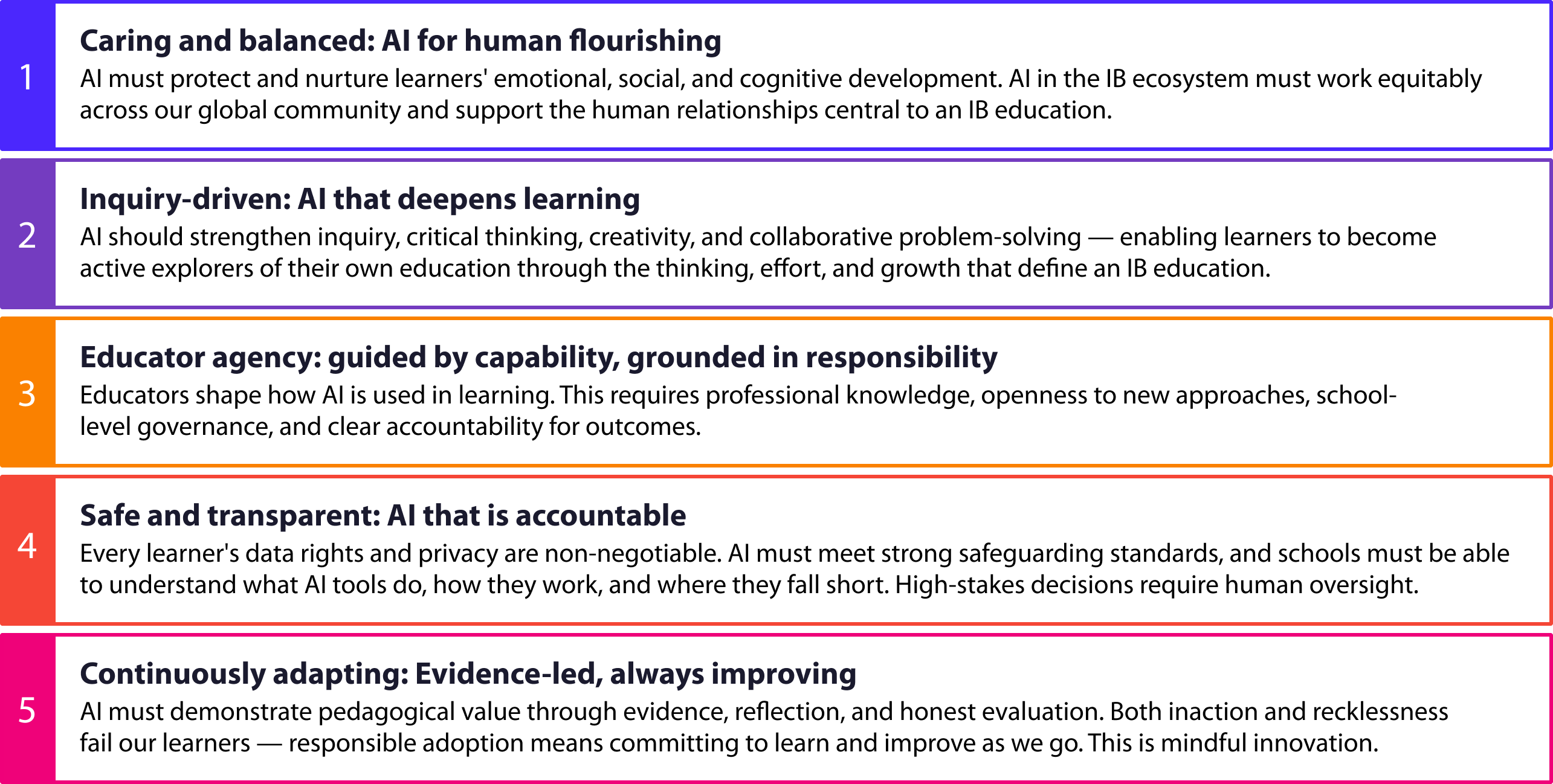 Image: Draft AI Principles for Human and Planetary Flourishing
- Caring and balanced: AI for human flourishing
AI must protect and nurture learners' emotional, social, and cognitive development. AI in the IB ecosystem must work equitably across our global community and support the human relationships central to an IB education. - Inquiry-driven: AI that deepens learning
AI should strengthen inquiry, critical thinking, creativity, and collaborative problem-solving — enabling learners to become active explorers of their own education through the thinking, effort, and growth that define an IB education. - Educator agency: guided by capability, grounded in responsibility
Educators shape how AI is used in learning. This requires professional knowledge, openness to new approaches, school-level governance, and clear accountability for outcomes. - Safe and transparent: AI that is accountable
Every learner's data rights and privacy are non-negotiable. AI must meet strong safeguarding standards, and schools must be able to understand what AI tools do, how they work, and where they fall short. High-stakes decisions require human oversight. - Continuously adapting: evidence-led, always improving
AI must demonstrate pedagogical value through evidence, reflection, and honest evaluation. Both inaction and recklessness fail our learners — responsible adoption means committing to learn and improve as we go. This is mindful innovation.
What comes next
We are sharing the principles in draft form because we meant what we said in the Digital Blueprint: we will co-create our future with our community, not deliver it to you finished.
Here is how we plan to develop them further:
Next steps for educators, school leaders, edtech partners and others: We will be running dedicated sessions at the IB Global Conference in Mumbai (March 2026) and at the African Education Festival in Johannesburg (April 2026) to discuss, challenge, and iterate these principles with you. We want to understand how these principles reflect shared values and local realities.
We invite you to complete a survey and share your recommendations on how the IB can better support our schools and broader ecosystem.
Next steps for the IB: We will continue working with the entire IB ecosystem to translate these principles into practical guidance — including a toolkit that helps schools move from principles to practice.
We are also developing the PRC Chatbot, a practical example of these principles in action, which we look forward to sharing with you soon.
This work is ongoing. We will share what we learn, be honest about what we don't yet know, and keep building with you.
From principles to practice: red lines and practical guidance
These principles will be supported by clear red lines. These are non-negotiable boundaries that define where AI must not go in the IB ecosystem. Red lines are not restrictions on innovation. They are what make confident innovation possible.
To illustrate how principles and red lines work together:
Our second principle states that AI should deepen learning. A related red line could be that high-stakes decisions about grading, progression, and well-being must never be fully automated.
What does this mean in practice?
For learners: your outcomes are never determined by an algorithm alone.
For educators: professional judgement remains central.
For EdTech partners: build tools that support human decision-making, not replace it.
We will share the full set of draft red lines and a practical toolkit for schools alongside the final principles later this year.
Our collaborators
We are grateful to the external advisors who have contributed their expertise to this work:
- Deepanshu Arora: Co-founder and CEO of Toddle, an AI-powered teaching and learning platform used by 2,000+ schools worldwide. Deepanshu brings experience at the intersection of pedagogy, product design, and education technology.
- Clara Hawking: Co-founder and Executive Director of Kompass Education, which develops AI governance frameworks for schools and EdTech companies. Clara brings deep experience in responsible AI integration in K–12 education, with a background in practical philosophy, applied ethics, and computer science, and previous experience leading AI strategy across 70+ international schools.
- Markku Pelkonen: Markku Pelkonen, Founder of Growth Resilience, advising education systems and organizations on AI-native transformation, learning culture, future-proof skills and leadership development. @growthmindsetbuilder
- Dr Yuhyun Park: Founder of the DQ Institute and a globally recognized authority on digital skills, ethics, and the digital economy. She created the Digital Intelligence (DQ) Framework (IEEE 3527.1™)—the global standard for digital literacy and skills—endorsed by the OECD, IEEE, and World Economic Forum, and implemented in over 100 countries. Dr. Park has advised the World Economic Forum, G20 Civil Society, national governments, and global companies including TikTok, Snapchat, and Aramco. Holding a Ph.D. in biostatistics from Harvard University and a bachelor’s in computer science and statistics from Seoul National University, Dr. Park continues to shape the global agenda for ethical and future-ready digital societies.
References
The following publications have informed our thinking:
- Brookings Institute — A New Direction for a Student in an AI World: Prosper, Prepare, Protect
- OECD — Digital Education Outlook 2026
- UNESCO — Guidance for generative AI in education and research
- European Commission — Ethical Guidelines on the use of Artificial Intelligence and data in teaching and learning for Educators
- DQ Institute — IEEE Standard for Digital Intelligence
How we worked
We adopted a ‘vibe teaming’ approach throughout this process, using AI to transcribe sessions, synthesise expert input, and help iterate drafts. This freed our team to focus on the thinking and judgement that mattered most. In doing so, we were able to practise the principles we are encouraging others to adopt.
