

In August, attendees from more than 25 universities took part in a three-day conference under the theme Empowering educators to thrive in a changing world.

On a Saturday night in Taipei, Taiwan, more than 100 teacher education practitioners from around the world were seated in a dining room at the city’s Grand Hotel. A string quartet played traditional Taiwanese ballads and Mozart sonatas. The instrumentalists were not your typical musicians for hire; they were top high school musicians now heading to university. It was only fitting that they were performing for attendees of the IB Educator Certificates Conference 2025.
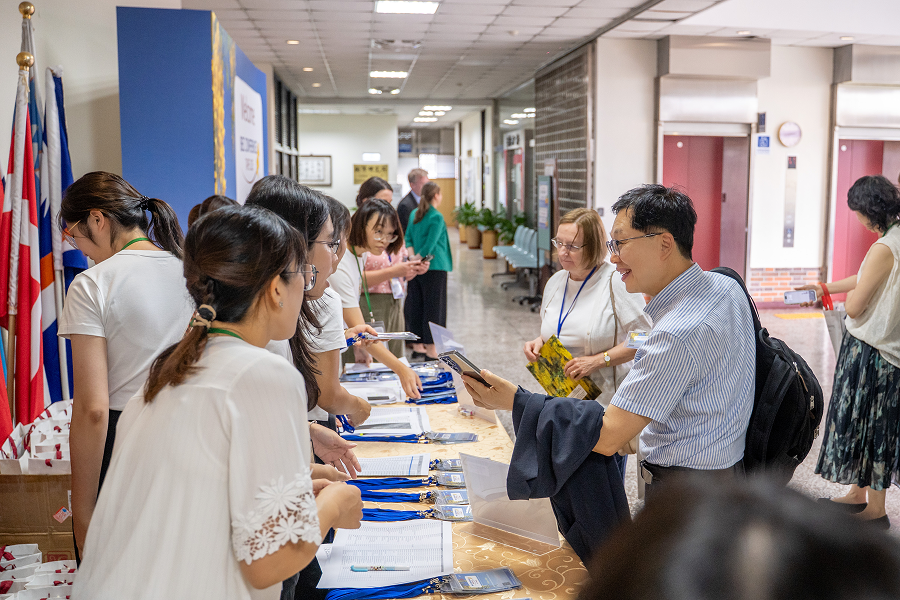
Members of the IB Educator Certificates (IBEC) community, including IB leaders and staff, gathered in Taipei for the IBEC Conference 2025. An IB credential that prepares educators to teach and lead in IB schools, IBEC is earned in conjunction with an education-related degree, with universities undertaking a rigorous and thorough application process to ensure their teacher education programmes align with the IB philosophy and pedagogy of inquiry-based and student-centered learning. This conference gave leaders and faculty at nearly 30 of these 55+ universities worldwide the opportunity to connect with one another, present their research and exchange ideas.

This joint effort between the IB and National Taiwan Normal University (NTNU)—the conference host and IBEC university—was the first IBEC Conference since COVID-19 halted the conference planned for 2020. The conference will return to being held every two years.
“I think people came together because they want to learn from each other’s experiences,” said Julie Ly Chu, lead of the IBEC programme at Vytautas Magnus University in Lithuania. Before the main conference, Chu took advantage of the pre-conference activity, paying visits to local IB World Schools.
About 40 attendees toured Taipei Municipal Binjiang Experimental Junior High School, where the principal, educators and students welcomed them to their campus. Hosts guided visitors on a tour through the building and introduced their school’s vision to help learners grow through teachings like creative action and compassionate engagement, and even showcased a Middle Years Programme personal project focused on reducing cigarette butt litter in the neighborhood.
The attendees then went on to Taipei Kuei Shan School, an IB continuum school. Here, the advisor to the board of trustees Li-Tien Wang invited everyone to reflect on how a campus can be designed to be student-centered, with elements like trees planted so students can see greenery when they look out the window.
The school visits, Chu said, brought to light “the variety that's out there when we're preparing IBEC teachers—but the core [of the IB philosophy] is the same.”
This idea was threaded throughout the three-day conference, with keynotes and special sessions dedicated to the importance of understanding various local contexts and practicing as IB educators in a rapidly evolving world. In welcome remarks from NTNU President Cheng-Chih Wu, he shared his own family’s experience with the IB, and the value of the IBEC programme at NTNU.
IB Chief Schools Officer Dr Nicole Bien also acknowledged the challenges we face, and opportunities ahead to focus education on flourishing. “In this polycrisis era,” Bien said, “the IB believes and is ready to shift the future of education toward a new purpose —one that focuses on human and planetary flourishing, and prioritizes the development of societies and communities that value meaning and purpose and live in harmony with one another and with the earth [...] This educational transformation must be accomplished through changes in the education workforce, namely teachers and leaders like yourself."
After the welcome, attendees heard from Chair Professor and NTNU Dean of the School of Learning Informatics Dr Chin-Chung Tsai, as the conference’s first keynote.
“Context shapes the students’ conception of learning,” said Tsai. As evidence, he offered his research on students’ vastly different conceptions of learning depending on their unique situations and on developing technology. The method of his research asked students to draw their perception of learning: Students learning post-pandemic, for instance, drew smartphones and computers, rather than stereotypical images of students at desks in a classroom.
The next keynote furthered the discussion, highlighting the IB’s opportunities and responsibility to learn from and actively incorporate different ways of knowing. Dr Akira Shah, Japan Society for the Promotion of Science Postdoctoral Fellow at Keio University, called for bringing contextual and expert knowledge to the forefront of IB education that moves beyond its Euro-American roots.
Shah’s research is grounded in his year of observation of IBEC programmes in Japan. “Our IBEC community teems with local knowledge,” he noted in his virtual presentation, asserting that the IBEC community has the power to successfully mesh IB and local education not only in IBEC environments, but also IB education as a whole—to move toward more humanly representative education.
Discussion about valuing different contexts wasn’t just heard in keynote speeches.
Gizem Güzeller of TED University in Türkiye reflected on the shared experiences of IBEC universities. “There are lots of people from different cultures, different countries and different contexts, but we all […] are talking about similar problems.” Güzeller, who presented a breakout session on how TED established its IBEC programme, said the conference offered a space for the IBEC community to try and find solutions together.
The IB also presented its own reflections on solutions to supporting numerous and diverse education systems based on the IB philosophy. Marc Neesam and Kiri Stevenson of the IB’s new Education Systems Solutions Team delivered a special session on the IB’s approach when it comes to guiding education systems —such as national or regional systems —in enhancing curriculum, assessment, teacher capacity and school innovation. The team wants to build upon existing systems, not transform them into something they are not —this work, Neesam and Stevenson said, will benefit from the vast experience of IBEC university faculty and staff.
Between the three keynotes, 26 breakout sessions, and nine poster presentations, attendees also immersed themselves in Taiwanese culture with calligraphy and tea-making lessons, as well as a martial arts demonstration by local elementary school students and traditional puppet show by I Wan Jan Puppet Troupe.

As conference-goers made their way into the campus auditorium for the final plenary of the event, they were presented with a final keynote. IB Director of Research, Policy and Design Dr Jen Merriman shared IB outcomes research, honing in on the IB’s student and teacher wellbeing research. Merriman also engaged attendees with tips for their own wellbeing as they return to the challenging work at their universities.
Attendees left inspired, acknowledging the opportunity the conference gave for problem-solving, commending one another's accomplishments, recognizing progress, and setting goals considering new perspectives.
“As the conference host, our aim is to provide a space where educators from diverse cultural backgrounds can connect, share experiences and build lasting relationships,” said Yvonne Yeh, head of the IBEC programme at NTNU. “The IBEC university community is small yet globally dispersed [...] Having a strong network of allies is crucial."
The energy that filled every IBEC Conference space demonstrated that IBEC—the institutions, their teacher educators, their educators in training—will take these connections forward to continue empowering educators.
Read NTNU’s article about the conference (in Chinese).
You also can learn more about IBEC and learn about offering IBEC at your university.
