

Robert Prescott, Senior Associate Dean at Bradley University; Costas Solomou, Vice President for Enrollment Management at SUNY Geneseo; Molly Witt, Senior Associate Director of International and Transfer Initiatives at the University of Vermont
Across very different institutions, one conclusion keeps emerging: IB students arrive ready—not just for university, but for the kind of learning higher education says it values most.
At Bradley University, SUNY Geneseo, and the University of Vermont, we have each spent time looking at how IB students learn, how they contribute on campus, and how well our policies truly recognize their preparation. What started as conversations about credit quickly became something broader: a question of values, trust and institutional honesty.
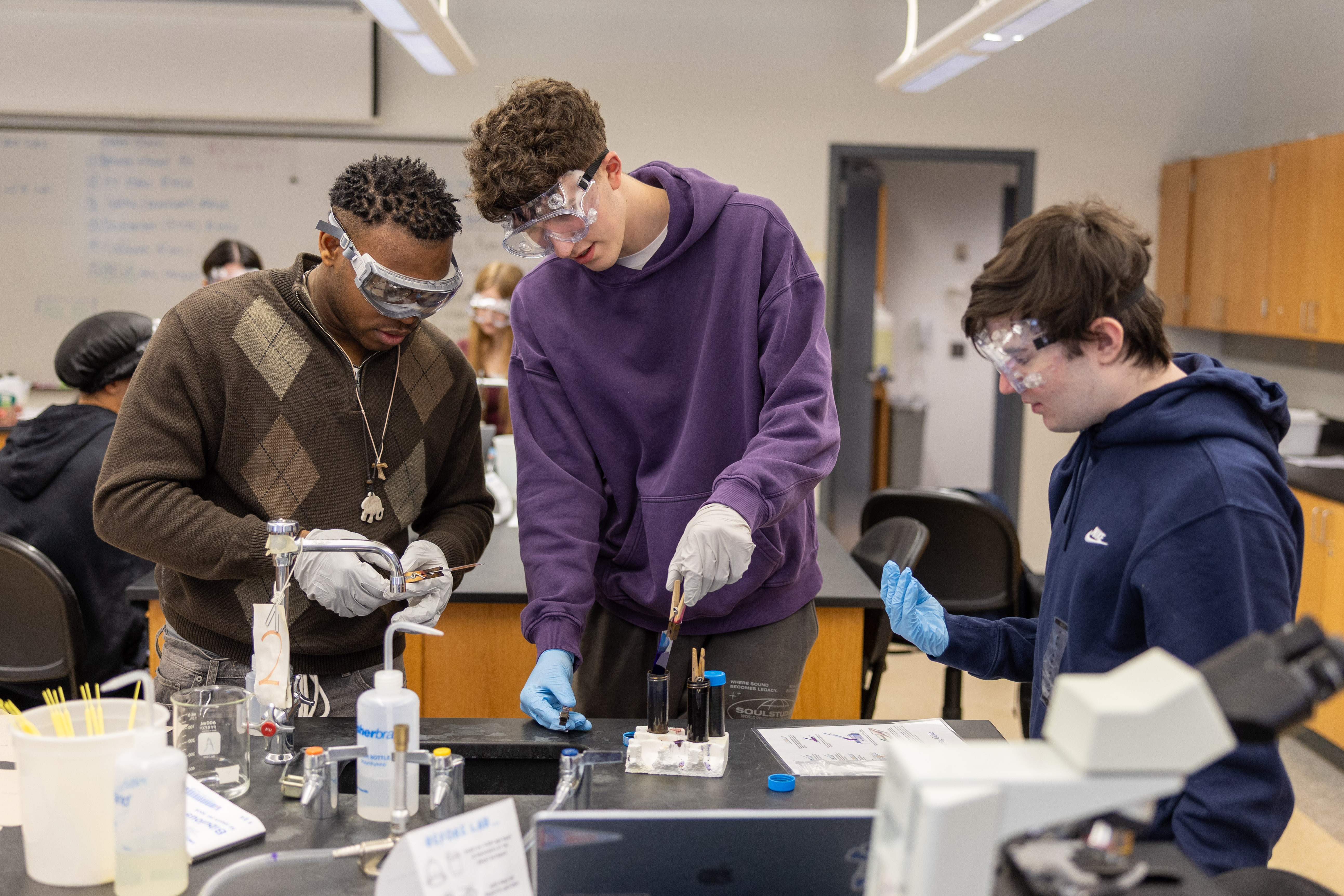
SUNY Geneseo students in a lab class.
Who we are and what we value
At Bradley University, a midsized private institution with a strong focus on faculty guided research and applied learning, we care deeply about students who are prepared to write, question, revise and engage seriously with complexity from day one.
At SUNY Geneseo, New York State’s public liberal arts honours college, academic excellence and access sit side by side. Our mission centres on integrative learning, equity, and students’ ability to connect ideas across disciplines and apply them beyond the classroom.
At the University of Vermont (UVM), we are a public research university on the shores of Lake Champlain, balancing the scale and opportunity of an R1 institution—an institution classified as having a very high level of research activity—with a close-knit academic community. Our students are deeply curious, environmentally engaged and motivated to make an impact, qualities reflected in our recognition as the Princeton Review’s #1 Best School for Making an Impact in 2024 and 2025.

UVM students on a trawling field trip.
Despite our differences in size, mission and structure, we are united by one experience: IB students feel at home on our campuses and raise the level of learning around them.
What we see when IB students arrive
IB students do not need to ease into university learning. They arrive already fluent in research, writing, sustained thinking and academic independence.
At Bradley, the difference between IB students and their peers is especially visible in writing. IB students arrive having written constantly, across subjects, with feedback and revision. When faculty engaged directly with IB exams, rubrics and curriculum documents, it became clear that this was not advanced high school work, but university-level learning already completed.
At Geneseo, IB students persist at higher rates, graduate at higher rates, and engage earlier in research, study abroad and independent scholarship. They contribute as leaders, mentors and global citizens, enriching classroom dialogue with perspective and curiosity.
At UVM, IB students integrate quickly into our academic community. They are confident in developing original arguments, synthesising sources, and managing long‑term projects. Those who completed the extended essay often draw directly on that experience in their first‑year writing and research‑based courses.
Why we reviewed our IB recognition policies
Each of us reached a similar realization: our students’ success was outpacing our policies.
At Bradley, once the faculty looked closely at the extended essay, theory of knowledge, and subject assessments, it became clear that IB students had been under‑recognized for years. Correcting that, even retroactively, was not generosity. It was about accuracy.
At Geneseo, strengthening IB recognition aligns directly with our mission of access and equity. Updating our policies ensured that credit recognition, scholarships, and academic pathways aligned with what IB students were already achieving.
At UVM, as we welcomed more IB students, we saw that our credit practices did not fully reflect the depth and breadth of the curriculum. Reviewing IB coursework—both higher and standard level, was a way to align policy with reality better.
How the work actually got done
Across all three institutions, progress depended on collaboration and evidence. Faculty leadership was essential. Subject experts reviewed IB syllabuses, assessments and rubrics. Registrars and provost offices ensured consistency and implementation. Admissions and enrollment teams contributed data, benchmarking and insight into student success. Student voices also played a critical role in highlighting where clarity and flexibility mattered most.

Bradley University students present research at an entrepreneurship expo on campus.
What better recognition makes possible
When IB recognition is done well, the benefits extend far beyond credit. Students gain flexibility to pursue double majors, study abroad, engage in research earlier or explore experiential learning more deeply. Institutions benefit from stronger recruitment, higher retention and academic communities enriched by globally minded, intellectually serious students.
Recognition is more than policy—it is a message
Recognizing IB well signals that an institution understands the whole student: their academic journey, their values and the skills they already bring. Done transparently and generously, recognition builds trust and strengthens institutional alignment with mission.
Shared takeaways
- IB students arrive university‑ready because they have already done university‑level work.
- Research, writing, critical thinking and reflection are embedded in the IB experience.
- Faculty‑led review is essential for genuine and trusted recognition.
- IB recognition advances equity and access, not just recruitment.
- Getting recognition right sends a powerful message about institutional values.
Across our institutions, one thing is clear: IB students are showing us what learning can look like at its best. Our responsibility as universities is to recognize that fully, and act on it.
